Upload Grocery List Csv for Onlin Store
Using CSV files to import and export products
This page was printed on Apr 12, 2022. For the current version, visit https://assist.shopify.com/en/transmission/products/import-consign/using-csv.
You apply a CSV (comma-separated values) file to import products into your Shopify store, and to consign products from your store. By using a CSV file, you lot can import or export a large number of products and their details at i fourth dimension. This can exist helpful if you want to exchange product information between Shopify and another system.
Learn how to open and edit a CSV file.
Download a sample CSV file
You can download and view a sample product CSV file to use equally a template.
-
The sample file contains an example product and a couple of variants. Your import file probably contains many more products and variants. If you utilize the sample file to create your own import file, and then make sure that you remove all the example products.
-
The sample file includes the Variant Inventory Qty column, which is merely used for stores that accept a single location. If yous use multiple locations and y'all want to import or consign inventory quantities, then utilize the inventory CSV file.
Considerations for the product CSV file
Before you utilise a product CSV file, review the following considerations.
Formatting the production CSV file
For your product CSV file to function correctly, verify the that it meets the following criteria:
-
The first line of your production CSV file must be the cavalcade headers as specified in the product CSV description table.
-
Each column must be separated by a comma.
Required columns in the product CSV file
These columns must exist present under the following conditions:
-
When you create a product CSV file to import new products, the but required cavalcade is Championship .
-
When you lot update products using a CSV file, the merely required columns are Handle and Title .
Data dependencies
Fifty-fifty though the Title and Handle columns are the only required columns when you update products using a CSV file, the data in some columns depends on the data in other columns.
For example, if you update a column that is related to variants, such every bit Variant SKU or Variant Grams , then the data in those columns depends on the information about the corresponding variants. In this instance, you must also include the Option1 Proper noun and Option1 Value columns.
Before you lot remove or exclude columns from your CSV file, verify whether the data in any other columns depends on the data in the columns that yous desire to remove or exclude. If your data depends on a column that is missing, then you receive an error when yous try to import your production CSV file.
Shopify Markets CSV columns
If you lot have Shopify Markets set up on your shop, so your CSV export reflects the unique markets that you created. By default your CSV has the Price / International and Compare At Price / International columns. But if you lot replace your international market with your ain market, then in the header proper noun, International changes to the name of the market.
For example, if you create a market for each individual continent, and one of your market place names is South America then column heading Price / International becomes Price / South America, and cavalcade heading Compare at cost / International becomes Compare at price / South America in the CSV consign file.
Columns in the production CSV file that must contain values
In addition to the Championship column, another columns must have a value. When a column requires a value, but is bare, and so a default value is created automatically in the following cases:
- The column is nowadays, just the values in that column are blank.
- The column is not present in the CSV file, merely the values can't be bare.
The following table describes which columns must have a value, and the default value that is created automatically if the column is blank.
| Column | Default value created when the column is bare |
|---|---|
| Handle | This value is created based on the value in the Title column. For case, if the value in the Title cavalcade is Black Dominicus Glasses, then the value in this column is black-sun-glasses. |
| Vendor | The proper name of the store as you entered it when yous created your Shopify account. For example, John'south Clothes or johns-apparel. This is the aforementioned shop name that you use when yous log in to Shopify. |
| Published | TRUE, which means that this production volition be published and available in the online store sales channel. |
| Option1 | Championship |
| Option1 Value | Default Title |
| Variant Inventory Quantity | 0 |
| Variant Inventory Policy | When the value is |
| Variant Fulfillment Service | manual |
| Variant Cost | 0.0 |
| Variant Requires Shipping | When the value is |
| Variant Taxable | True |
| Variant Grams | 0.0 |
| Variant Weight Unit of measurement | kg |
| Price / International | If you sell internationally, then this is the price of the product or variant. But include the price. Don't include any currency symbols. For case, This column heading proper noun varies depending on the Shopify Markets that you have ready on your store. The default market is Acquire more than about how overwriting existing products affects the data in this column. |
| Compare At Price / International | If you sell internationally, then this is the "Compare at Price" of the product or variant. Only include the price. Don't include any currency symbols. For example, This column heading name varies depending on the Shopify Markets that yous take set up up on your store. The default market is Acquire more virtually how overwriting existing products affects the data in this column. |
| Status | active |
For more information almost these and other columns, refer to the production CSV clarification table.
Overwriting production details using an import CSV file
When you import a CSV file, yous can select the option Overwrite any current products that accept the same handle. Existing values will be used for whatsoever missing columns. If you lot select this option, then when the handle in the import CSV file matches an existing handle in your products listing, the values in CSV file overwrite the values in the matching columns in the existing product list. If the overwrite option isn't selected, so the products that match an existing handle will be ignored during CSV import.
-
If a required column in the import CSV file is bare, then the matching value in the product list is overwritten as blank.
For instance, the Standardized Production Type value in your existing production listing is
John'due south Apparel, but the Standardized Product Type column is blank in the CSV file that yous import, then theJohn'southward Apparelis overwritten as blank. -
If a non-required column is non included in the import CSV file, only is included in the existing product list, then the value in the product listing remains the same.
For example, if the Variant Image column is included in the existing production list, but that column is non included in the import CSV file, so the value in the production list remains the aforementioned.
Description of the product CSV file
For data about which columns are required, and which columns crave that values are entered, refer to the considerations for product CSV files.
| Column | Description |
|---|---|
| Handle | Handles are unique names for each production. They can incorporate letters, dashes, and numbers, but no spaces, accents, or other characters, including periods. Handles are used in the URL for each production. For example, the handle for a "Women's Snowboard" should be Every line in the CSV file that starts with a different handle is treated as a new product. To add multiple images to a production, y'all must add multiple lines with the same handle. |
| Title | The title of your product. For example, |
| Trunk (HTML) | The clarification of the product in HTML format. Acquire more most how overwriting existing products affects the information in this column. |
| Vendor | The name of the vendor for your product. For example, Values must exist at least two characters long. Acquire more than most how overwriting existing products affects the data in this column. |
| Standardized product type | A label that describes the type of product. This label must be taken from the predefined standardized list of production types. You tin input the standardized product type in either of the following means:
Learn more about adding a standardized production blazon Learn more than about how overwriting existing products affects the data in this column. |
| Custom product type | A custom label that describes the category of a product. This label doesn't demand to conform to any predefined format. Learn more about adding a custom product type Learn more about how overwriting existing products affects the data in this cavalcade. |
| Tags | A comma-separated listing of tags used to tag the product. Most spreadsheet applications automatically add quotes around the tags for you. If you use a patently text editor, so y'all demand to manually add the quotes. For instance, Learn more than about how overwriting existing products affects the data in this column. |
| Published | Indicates whether a product is published on your online store. Valid values are |
| Option1 Name | If a production has an option, and then enter its name. For example, If a production has only one option, then this value should be |
| Option1 Value | Circumspection: Irresolute data in this cavalcade deletes existing variant IDs values, and creates new variant IDs. Any change to variant ID values can pause third-party dependencies on variant IDs. If a product has an option, and so enter its value. For example, If a product has only one choice, then this value should exist |
| Option2 Name | If a product has a 2d option, so enter its name. For example, Learn more than about how overwriting existing products affects the data in this column. |
| Option2 Value | Caution: Changing data in this column deletes existing variant IDs values, and creates new variant IDs. Whatever change to variant ID values can break third-party dependencies on variant IDs. If a product has a 2d option, and then enter its value. For case, Acquire more about how overwriting existing products affects the data in this column. |
| Option3 Name | If a production has a 3rd pick, so enter its name. Larn more than well-nigh how overwriting existing products affects the information in this cavalcade. |
| Option3 Value | Caution: Changing data in this cavalcade deletes existing variant IDs values, and creates new variant IDs. Any change to variant ID values tin can break third-party dependencies on variant IDs. If a product has a third option, then enter its value. Learn more virtually how overwriting existing products affects the data in this column. |
| Variant SKU | The SKU of the production or variant. This is used to track inventory with inventory tracking services. This field can't exist left blank if y'all're using a custom fulfillment service . Learn more virtually how overwriting existing products affects the data in this cavalcade. |
| Variant Grams | The weight of the product or variant in grams. Don't specify a unit or use decimals. For example, for a weight of 5.125 kg, enter Shopify always imports and exports the weight in grams, fifty-fifty if you specify a different unit. Y'all must use accurate weights if y'all intend to offer carrier-calculated aircraft or use a tertiary-political party fulfillment service. |
| Variant Inventory Tracker | Include your inventory tracking for this variant or product. Valid values include If the existing inventory tracking options are removed, then inventory is no longer tracked. Learn more virtually how overwriting existing products affects the data in this column. |
| Variant Inventory Qty | The number of items yous have in stock of this production or variant. This cavalcade is only used for Shopify stores that have a single location. Note: This cavalcade is simply available for shop that take only one location. If your shop manages inventory at multiple locations, then this column isn't included. If you lot want to import or consign inventory quantities, and so use the inventory CSV file. Learn more than well-nigh how overwriting existing products affects the information in this cavalcade. |
| Variant Inventory Policy | How to handle orders when the inventory level for this product or variant has reached nada. Variants with a |
| Variant Fulfillment Service | The production or variant fulfillment service used. The following are the valid values for this column:
If you lot utilize a custom fulfillment service, then yous can add the name of the service in this column. For the custom name, utilise simply lowercase letters. Spaces aren't allowed and you must replace them with a nuance (-). Periods and other special characters are removed. For instance, if "Joan's Fulfillment" is your fulfillment service's name, enter Y'all must have a custom fulfillment service prepare in your Shopify admin earlier y'all can add the name of the service in this column. |
| Variant Price | The price of the product or variant. But include the toll and don't include any currency symbols. For example, |
| Variant Compare at Price | The "Compare at Price" of the product or variant. Only include the price and don't include any currency symbols. For example, Learn more nearly how overwriting existing products affects the data in this column. |
| Variant Requires Shipping | The option to require shipping. Valid values are |
| Variant Taxable | Use taxes to this variant. Valid values are |
| Variant Barcode | The barcode, ISBN, or UPC of the product. Larn more about how overwriting existing products affects the data in this column. |
| Image Src | Enter the URL for the production image. Shopify downloads the images during the import and re-uploads them into your store. These images aren't variant-specific. The variant image column is where you lot specify variant images. You tin't change the image file proper noun later that image has been uploaded to your shop. Don't upload images that accept Learn more well-nigh how overwriting existing products affects the data in this column. |
| Image Position | Enter the number that represents the order in which you desire the image to announced on the product'south page. The images appears in social club from smallest to largest starting from an image position value of Learn more most how overwriting existing products affects the information in this column. |
| Image Alt Text | Alt (alternate) text describes an prototype and is an important role of a production description. If an image tin can't load for any reason, then alt text is shown instead. It's likewise used by assistive technology to depict an image to a customer who's visually dumb. Including alt text volition heave your website's SEO. Keep your alt text brief and descriptive. The maximum length is 512 characters, merely the optimal length is 125 characters or fewer. Acquire more nigh how overwriting existing products affects the data in this column. |
| Gift Card | Indicates whether the product is a souvenir card. Valid values are Larn more than about how overwriting existing products affects the data in this column. |
| SEO Title | The SEO Title is found on a production's details page under the Search engine list preview header in the Page title field. The SEO Championship is alphanumeric and can include up to seventy characters. If you lot leave this column bare when you import a product, then the value in the Title cavalcade is entered into the Folio title field on the product's details page. Learn more about how overwriting existing products affects the data in this column. |
| SEO Description | The SEO description is also institute on a production's details folio under the Search engine listing preview header in the Clarification. The SEO description is alphanumeric and can include up to 320 characters. If you lot exit this column blank when yous import a product, and so the value in the Torso (HTML) cavalcade is entered into the Description field on the product'southward details page. Learn more almost how overwriting existing products affects the data in this cavalcade. |
| Google Product Category | If you currently employ a Google production category, you can use it as your Shopify standardized product type. You tin can apply the standardized product type, the Google Production Category, or both. Provide the most specific category possible for each item. The Google Product Category (GPC) (google_product_category) uses Google's product taxonomy. You lot tin input the Google product category in either of the following means:
Learn more about how overwriting existing products affects the data in this column. |
| Google Shopping metafields | The Google Shopping columns might exist used by an app to synchronize products to the Google Merchant Center. However, Shopify'due south Google channel doesn't utilize these metafields. Y'all can ignore values in the columns that include Google Shopping in their names unless an app tells you to apply them. Larn more than about how overwriting existing products affects the data in this column. |
| Variant Paradigm | The URL for images of variants. If you add together an URL, then it must exist a operation image URL. Learn more than virtually how overwriting existing products affects the data in this column. |
| Variant Weight Unit | Valid values are |
| Variant Tax Lawmaking | Available to: Shopify Plus plan The Avalara code to utilise taxes to this product. This field only applies when you import to or export from a store that uses the Shopify Plus plan'south integration with Avalara AvaTax. When you create a CSV file past exporting products from a store that uses Avalara, the Variant Tax Code column is filled. If y'all import this CSV file into a store that doesn't accept Avalara set up, then your import fails. Learn more than about how overwriting existing products affects the data in this column. |
| Cost per item | How much information technology costs you for the product or variant. Only include the cost. Don't include any currency symbols. For example, Learn more about how overwriting existing products affects the data in this column. |
| Condition | Indicates whether a product is bachelor to your customers. Valid values are:
|
Drove column exception
To organize your products into collections during the CSV file upload, you lot can add together a new cavalcade anywhere in your CSV file with the header name Collection.
When y'all export a CSV file, the Collection cavalcade is non included.
| Cavalcade | Description |
|---|---|
| Collection | Enter the proper noun of the collection that you want to add this production to.
You can add together a production to only one collection. This value can be blank. Learn more near how overwriting existing products affects the data in this column. |
Create your production CSV file
For each product, you lot need to determine if it'due south a elementary product or one with variants.
-
Uncomplicated product: A simple product doesn't include variants. If y'all upload a product that doesn't have variants, then enter all the fields for the product in the offset row along with the URL for the first prototype. In the following rows, just enter the handle and the URL for each additional image.
-
Production with variants: If y'all upload a product that has variants, then enter all the fields for the production in the showtime row along with the URL for the showtime epitome. In the following rows, enter the handle. So skip the Title, Trunk (HTML), Vendor, and Tags columns. Fill out the rest of the variants' details and each image URL.
Later on y'all've added all your products and images, save your CSV file in UTF-8 format using LF-style linefeeds. If you're non familiar with encodings, and then see your spreadsheet or text editor program'due south documentation.
To view an example CSV file, download this sample product CSV file, and then open up it in Google Sheets or another spreadsheet program.
Prepare your images
A CSV file can only contain text, therefore, you demand to make sure that all production images are on an existing website. Those prototype URLs are but used during the CSV file importing process. You can delete the URLs afterward your import is complete.
-
If the files are only on your computer, so to link to their URL, you must upload them to your Shopify store or to another paradigm hosting service.
-
If you're switching to Shopify from another platform, then you lot can re-create the current image URLs and use them in the CSV file.
-
If the production CSV file was produced by exporting your products from Shopify, then you don't need to do anything because your images are already on your website.
When you have URLs for each product image, you can kickoff edifice your CSV file.
Adding multiple production images in a CSV file
You can add together more than production images to your CSV file by uploading more images to your Shopify admin. If y'all're edifice your Shopify store with a CSV file, and so the process is a little different. Review the following considerations:
-
You need to be able to edit a CSV file. Shopify recommends using Google Sheets to view a formatted version of your CSV files.
-
You tin can add up to 250 images to a product.
-
Your product images must be uploaded to a publicly accessible URL. That is, they should exist behind an
https://protocol with no password protection. To practise this, y'all can upload images to the Files page of the Shopify admin. The URLs generate automatically. After you lot click Upload files, you tin select up to a couple hundred images to upload in bulk.
Add together multiple product images to your CSV file
- Insert new rows. You must use but one row per image.
- Copy and paste the handle.
- Copy and paste the image URLs.
Insert a new row
-
Open up your CSV file in your spreadsheet program, such every bit Google Sheets.
-
Locate the products that you desire to add together images to.
-
In the next row, click and drag the row numbers to select multiple rows. Select the same number of rows as the number of boosted images y'all add.
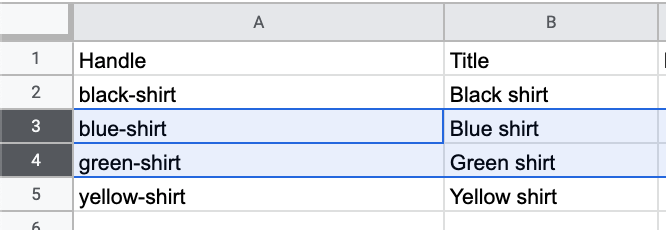
-
While those rows are highlighted, right-click anywhere in the highlighted area, and then select Insert Ten rows higher up.
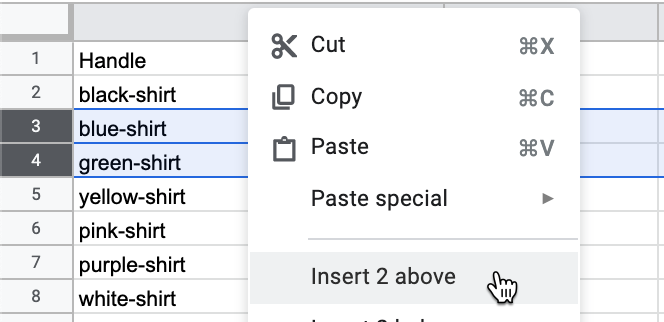
Copy and Paste the Handle value
- Copy and paste the Handle value of the required product into column A for your new rows.
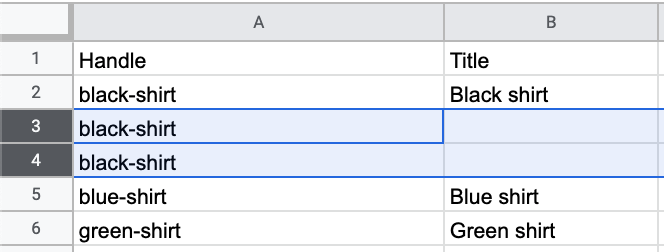
Re-create and Paste the image URLs
-
On the Files page, upload your images to Shopify.
-
Click the Copy link icon for 1 image URL at a time.
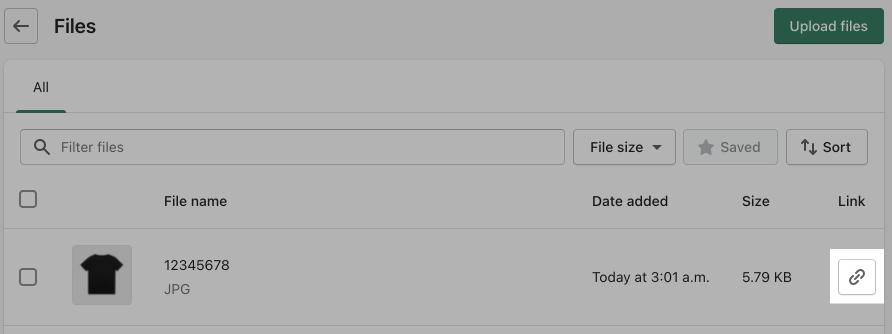
-
In the CSV file in your spreadsheet application, scroll sideways to the last columns of the CSV file.
-
In the Epitome Src column, paste the image URL into each line.
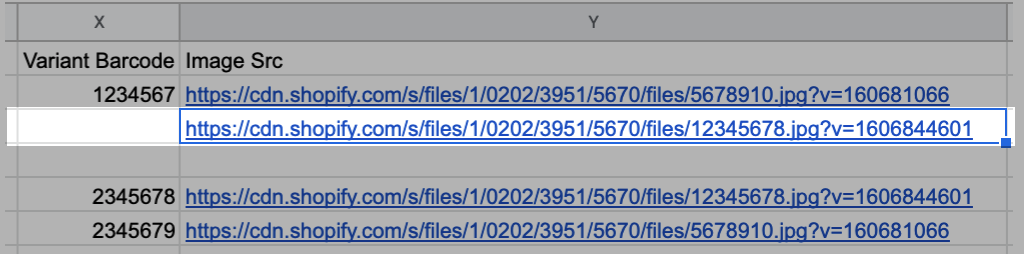
-
Repeat steps 2 to iv for all the images for this product
-
Optional: To improve your SEO, enter values into all the Image Alt Text fields. Acquire more about Image alt text.
-
Salvage the CSV file and import it to Shopify.
Source: https://help.shopify.com/en/manual/products/import-export/using-csv
0 Response to "Upload Grocery List Csv for Onlin Store"
Post a Comment