what is black man to black woman ratio
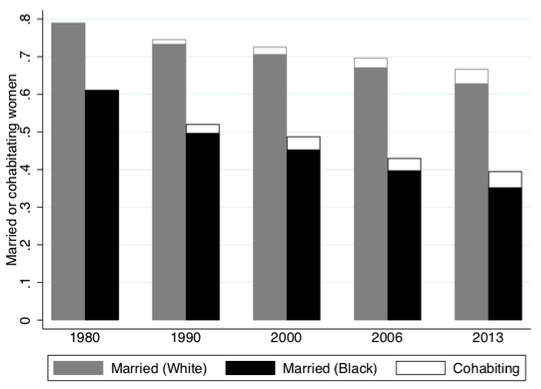
The blackness–white differences in marriage in the U.s. are striking. In 2006, 67% of white women between ages 25 and 54 were married, while only 34% of black women were – a gap of 33 pct points. And as Figure 1 shows, the racial union gap has been increasing – information technology was 17 percentage points in 1980. The differences in family structure between blackness and white households have been an ongoing business for policymakers. In his famous report, Moynihan (1965) saw a articulate link betwixt family construction and growing social problems, such as poverty and law-breaking, among the black population. Today, the growing racial gap in marital condition of the US population has led some researchers to question whether marriage is simply for white people (Banks 2011).
Figure one Share of married or cohabiting black and white women across fourth dimension
This dramatic racial gap in marriage matters because marital structure has important implications for the living arrangements and well-existence of children. In 2015, most 54% of black children lived with a single mother, while the share of white children living with a single mother was well-nigh 22%.1 Differences in family construction are a contributing gene to differences in economic resources. In 2006, 33% of blackness children were living below the poverty line, while only xiv% of white children were.two A growing body of literature suggests that the conditions under which children grow up matter for their well-being as adults. Carneiro and Heckman (2003) and Cunha et al. (2006), among others, bear witness that differences between children appear at very early ages and that the family environs plays a meaning role in generating these differences.
Why do blackness individuals ally at lower rates than white individuals? Wilson (1987) suggests that characteristics of the blackness male population, and in item the lack of marriageable black men due to high rates of unemployment and incarceration, are an of import factor contributing to the black-white differences in marital condition. This is normally referred to equally the 'Wilson hypothesis'.
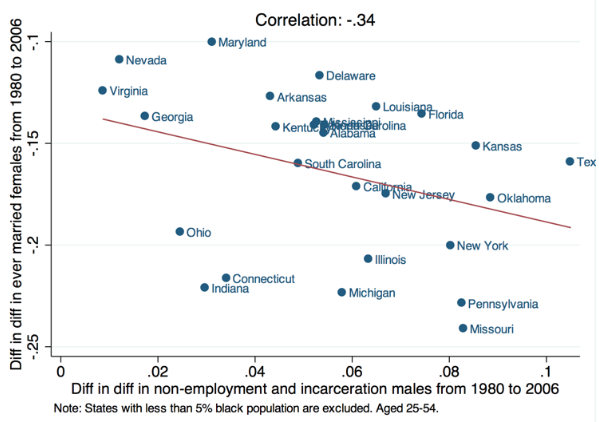
Effigy ii illustrates this hypothesis. The horizontal centrality shows by how much more the share of incarcerated or non-employed men increased for black men than for white men from 1980 to 2006 across United states states, while the vertical axis shows by how much more the share of never-married women declined for blackness than for white women. In Pennsylvania, for case, the share of men without a job or in prison increased by 8 percentage points more for blackness men than for white men. At the same time, the share of women who were never married dropped by 23 percentage points more for black women than for white women. Larger increases in incarceration for men are associated with larger declines in marriage for women.
Effigy ii Changes in not-employment and incarceration of males in relation to the reject in ever married females
Since the 1970s, there take been two major developments disproportionately affecting the riskiness of black men as spouses.
Showtime, in that location has been a large withdrawal of major industries from the inner cities due to skill-biased technological modify and globalisation, leaving many low-skilled men without jobs. Betwixt 1980 and 2000, the Usa lost two one thousand thousand manufacturing jobs and the turn down has accelerated significantly since 2000 (Charles et al. 2018). These losses have been virtually pronounced for those with depression levels of instruction. Batistich and Bond (2018) detect that Japanese import competition in the 1970s and 1980s was associated with skill-upgrading in manufacturing and generated a shift of employment from low-skilled black workers to loftier-educated white workers. As a consequence, black men between the ages of 25 and 54 are less likely to be employed (sixty% versus 85% in 2006) and more likely to be unemployed (7.iii% versus 3.6% in 2006) than their white counterparts.
Why did incarceration skyrocket? The development can exist traced back to a press conference in 1971, in which President Richard Nixon alleged illegal drugs every bit public enemy number one. In 1982, President Ronald Reagan officially announced the 'War on Drugs', leading to the introduction of several policy packages. These reforms entailed a substantial increase in anti-drug funding and incentives for police force agencies to arrest drug offenders, and sentencing reforms including harsh punishments for crack distribution and possession. As a consequence, the prison population soared. In 2010 more than than ane in 10 black men between the ages of 25 and 54 were incarcerated. This is more than than five times as high every bit the incarceration rate for white men of the aforementioned age. Prison has go a mutual feature of a black man's life. For blackness men born between 1965 and 1969, the cumulative risk of imprisonment by ages 30 to 34 was 20.5% compared to just two.nine% for white men (Western 2006). More than than half of black men with less than a loftier school education pass through prison at some point before they plow 34.
Even when focusing on the civilian, non-institutionalised population, there are more black women than men due to higher bloodshed rates of black men. The numbers of white men and women of marriageable ages are nearly even, i.e. there is one human for every woman. In dissimilarity, there are around 15% more black women between the ages of 25 and 54 than black men. This skewed sexual activity ratio for the black population makes it less likely blackness women volition marry.
In a recent paper (Caucutt et al. 2018), we take a dynamic look at the Wilson hypothesis in order to sympathise the sources of the racial marriage gap. Nosotros develop an equilibrium model of matrimony, divorce, and labour supply that takes into account the transitions between employment, unemployment, and prison house. Our analysis differentiates betwixt the lack of opportunities for blackness women to come across black men and their decision to enter into a matrimony. Given electric current incarceration policies and labour marketplace prospects, black men are riskier spouses than white men. They are more than likely to be, and to become, unemployed or incarcerated than their white counterparts. Equally a issue, matrimony is a risky investment for black women.
In the model economy, single men and women, who differ by earning potentials, are matched in a marriage marketplace segmented past race. They decide whether or not to marry taking into account their adjacent all-time option. Husbands and wives besides decide whether to stay married and whether the married woman works in the labour market. There is a authorities that taxes and provides welfare benefits to poor households. Men in the model motility exogenously among three labour marketplace states (employment, non-employment, and prison).
Black and white individuals differ forth three key dimensions. First, there are more blackness women than black men, so the sex ratio for the black population is not one. Second, blackness men are much more likely to go to prison than white men. Third, black men are also more likely to lose their jobs. Because there are more than blackness women than black men and a large number of blackness men are in prison, single black women might non meet anyone in the matrimony market. Furthermore, considering black men are more likely to become to prison or lose their jobs, when meetings do take place they are less likely to be finish up in marriage, and existing marriages are more than likely to end in divorce.
The model economy is estimated to be consistent with key marriage and labour market statistics by gender, race, and educational attainment for the The states economy in 2006. Without imposing racial differences in taste parameters, the model is able to generate a racial matrimony gap of 24 percentage points for currently married females. We and then study how much the different components of the Wilson hypothesis – the sex ratio, and the dynamic impacts of the prison and employment transitions – contribute to this racial marriage gap. Tabular array 1 documents our results.
Table ane Bookkeeping for the black-white marriage gap (fraction married)
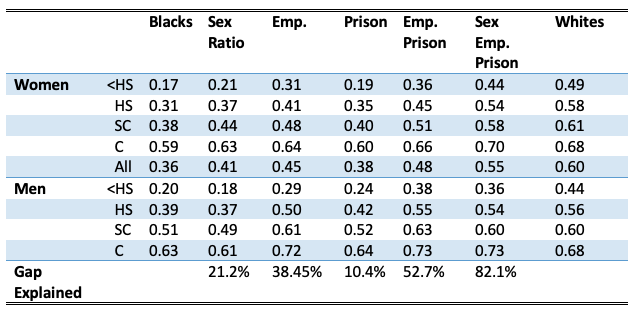
Notes: Cavalcade 'Black' shows the share of married black women (above) and men (beneath) by education in the benchmark economy, while the column 'White' shows the aforementioned for white women and men. Column 'Sex Ratio' shows the counterfactual marriage rates of blacks if the sexual activity ratio were equal to i. Column 'Emp' shows the counterfactual spousal relationship rates of blacks if black men had the aforementioned employment transitions as white men of equal education. Column 'Prison' shows the counterfactual marriage rates of blacks if black men had the same prison house transitions equally white men of equal education. The bottom rows show the share of the marriage gap explained through the respective counterfactual experiments and the associated ninety% confidence interval. '<HS' denotes educational activity level of 'less than high school', 'HS' is loftier school, 'SC' is 'some higher', and 'C' is college.
The get-go column of Table 1 shows the fraction of the black population that is married in the model economy, while the final column shows the fraction of the white population that is married. At every education level, a larger fraction of the white population are married. For women with less than a high school degree, for example, nearly l% of white women are married, while just 17% of black women are.
In each column between the starting time and the concluding one, we eliminate the gap for one key racial divergence. Starting time, nosotros give an equal sex ratio to the black population ('Sex activity Ratio'). Adjacent, we give black men the employment opportunities of white men ('Emp.'). Finally, we give blackness men the incarceration rates of white men (cavalcade 'Prison'). In each of these columns the marriage rate amongst the black population increases and approaches the marriage rate for the white population in the model economy. The last row in the table shows how much of the racial marriage gap each cistron closes. We detect that the sex ratio accounts for 21.2% of the gap. The event of employment is larger 38.4%, while the effect of prison is smaller 10.4%. Next, we consider the different factors together. If black men face the employment and prison house dynamics of white men, the racial wedlock gap is reduced by more than than 50%. Finally, putting together all iii pieces of the Wilson hypothesis (eliminating black-white differences in the sex ratio, incarceration transitions, and unemployment transitions) closes more than fourscore% of the racial union gap.
Conclusions
A racial wedlock gap of 33 percentage points is broad. In our inquiry, we report the potential drivers of this gap. Changes in US labour markets in recent decades left many low-skilled workers jobless. The number of people behind bars has increased so that the The states now holds 25% of the world's prison population, while but accounting for about five% of the earth's population. Both the decline in low-skilled jobs and the era of mass incarceration accept disproportionately affected black communities, and in detail black men. Nosotros investigate whether the electric current bleak labour market prospects of black men and the considerable risk of being incarcerated can explicate why so many black women are not marrying. Using an equilibrium model of marriage, divorce and labour supply that takes into business relationship transitions between employment, unemployment, and prison house, we are able to disentangle and quantify the key contributors to the racial spousal relationship gap.
References
Banks, R R (2011), Is wedlock for white people? How the African American marriage reject affects anybody, Dutten: New York.
Batistich, Chiliad K, and T N Bond (2018), "Symptoms before the syndrome? Stalled racial progress and Japanese trade in the 1970s and 1980s", mimeo.
Carneiro, P, and J J Heckman (2003), "Human capital letter policy", in J J Heckman, A B Krueger and B M Friedman (eds.), Inequality in America: What Role for Human Capital Policies?, MIT Press.
Caucutt, E, Northward Guner and C Rauh (2018), "Is wedlock for white people? Incarceration, unemployment, and the racial marriage divide", CEPR Word Paper 13275.
Charles, Thou Thou, E Hurst and Chiliad Schwartz (2018), "The transformation of manufacturing and the decline in US employment", NEBR working paper w24468.
Cunha, F, J J Heckman, Fifty J Lochner and D V Masterov (2006), "Interpreting the bear witness on life wheel skill formation", in E A Hanushek and F Welch (eds.), Handbook of the Economics of Education, N-Holland-Elsevier.
Moynihan, D P (1965), "The Negro family: The case for national activeness", Office of Policy Planning and Research, United States Section of Labor.
Western, B (2006), Punishment and inequality in America, Russell Sage Foundation.
Wilson, Due west J (1987), The truly disadvantaged: The inner city, the underclass, and public policy, Chicago University Printing.
Endnotes
[1] The Usa Census data on the Living Arrangements of Children, Tables CH2 and CH3 (https://www.census.gov/data/tables/time-serial/demo/families/children.html)
[two] The The states Census data on Historical Poverty Tables: People and Families - 1959 to 2015. Table 3 (http://world wide web.demography.gov/information/tables/time-serial/demo/income-poverty/historical-poverty-people.html).
Source: https://voxeu.org/article/incarceration-unemployment-and-black-white-marriage-gap-us
0 Response to "what is black man to black woman ratio"
Post a Comment