2nd Biopsy for Cervical Cancer if Comes Back Unnormal Again What Next
Near women who receive aberrant cervical cancer screening results either accept human papillomavirus (HPV) infections or have early on cell changes that can be monitored (since they often go abroad on their own) or treated early (to prevent the development of cervical cancer). The information on this page can help you lot to learn more about abnormal cervical cancer screening results and follow-upward tests and treatments.
HPV infection
Human papillomaviruses (HPVs) are a group of related viruses, some of which are spread through sexual contact. Some of these HPV types, called high-risk HPV, crusade nearly all cases of cervical cancer. They can besides cause anal cancer, penile cancer, vaginal cancer, vulvar cancer, and oropharyngeal cancer (cancer in the throat, usually the tonsils or the dorsum of the natural language).
Acquire more near how HPV causes cancer in HPV and Cancer.
HPV test and Pap test (Pap smear)
The HPV exam and the Pap examination are ii different cervical cancer screening tests. Screening means checking for a affliction or for changes that may develop into illness before there are symptoms. Women need routine cervical cancer screenings fifty-fifty if they feel fine. Screening tin can help find changes in cervical cells and so y'all tin can receive the proper follow-up care and handling you need to stay healthy.
The HPV test checks cells for infection with high-risk HPV types.
The Pap test (likewise chosen a Pap smear or cervical cytology) collects cervical cells and looks at them for changes acquired by HPV that may—if left untreated—plow into cervical cancer. It can also detect cervical cancer cells. A Pap exam too sometimes finds conditions that are not cancer, such as infection or inflammation.
The HPV/Pap cotest uses a Pap exam and HPV test together to bank check for both high-take a chance HPV and cervical prison cell changes.
What is the neck?
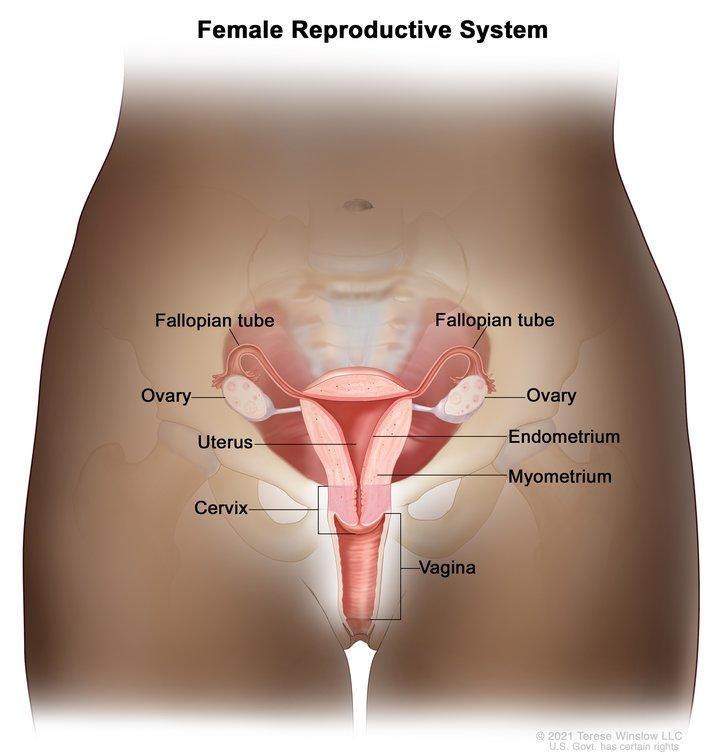
Anatomy of the female reproductive system. The organs in the female reproductive system include the cervix, uterus, ovaries, fallopian tubes, and vagina.
The cervix is the lower, narrow end of the uterus, which leads to the vagina. The cervix opens during childbirth to permit the babe to laissez passer. It's part of the female reproductive system, as shown in the image to the right.
What to wait during an HPV or Pap examination
Both types of cervical cancer screening tests are usually washed during a pelvic exam, which takes only a few minutes. During this exam, y'all lie on your back on an examination table, curve your knees, and put your anxiety into supports at the end of the tabular array. The health care provider uses a speculum to gently open your vagina in social club to encounter the cervix. A soft, narrow brush or tiny spatula is used to collect a small sample of cells from your neck.
The sample of cervical cells is sent to a lab, where the cells tin exist checked to see if they are infected with the types of HPV that cause cancer (HPV examination). The same sample tin can be checked for abnormal cells (Pap test/Pap smear). When both an HPV test and a Pap test are done on the same sample, this is chosen HPV/Pap cotesting.
A pelvic exam may include more than taking samples for an HPV and/or Pap test. Your wellness care provider may too cheque the size, shape, and position of the uterus and ovaries and feel for any lumps or cysts. The rectum may also be checked for lumps or abnormal areas. Most health care providers will tell you what to expect at each pace of the test, so you lot will exist at ease. You lot may likewise enquire to be tested for sexually transmitted infections (STIs), too called sexually transmitted diseases (STDs).
Where to become cervical cancer screening: Clinics that offer screening
Doctors' offices, clinics, and community wellness centers offer HPV and Pap tests. Many women receive these tests from their ob/gyn (obstetrics/gynecology) or main care medico. If you don't accept a chief care provider or medico y'all see regularly, y'all tin can notice a clinic well-nigh you lot that offers cervical cancer screening by contacting:
- your country or local wellness department
- the National Breast and Cervical Cancer Early Detection Plan (NBCCEDP) or call 1-800-232-4636; NBCCEDP provides low-income, uninsured, and underserved women admission to timely cervical cancer screening and diagnostic services
- a Planned Parenthood clinic, or phone call 1-800-230-7526
- NCI'southward Cancer Information Service (CIS), or call one-800-422-6237
Questions to ask earlier and after your exam
Before your exam:
Ask your wellness care provider:
- What tests will I accept?
- What is the purpose of these tests?
- What will happen during the exam?
- Will I accept whatsoever discomfort?
Your health care provider may ask yous:
- What was the offset date of your final menstrual period?
- When did you have your concluding cervical cancer screening test?
- Have yous always had whatsoever abnormal test results or treatment for abnormal cells on your neck?
After your exam:
Ask your health intendance provider:
- When will I get my test results?
- How volition I become these results (e.k., by mail, online, or a phone call)?
- What phone number should I call if I do not get my test results?
- When I get my results, will they explain what I should practise adjacent?
Screening guidelines: When and how often to go screened for cervical cancer
Cervical screening recommendations have been adult by several organizations, including the United states of america Preventive Services Task Forcefulness (USPSTF), the American Cancer Lodge (ACS), and others.
The details of the recommendations vary, but all are based on research findings, including:
- HPV-caused changes in cervical cells happen slowly and often go away on their own, especially in younger women
- more effective screening tests
- the harms of overtesting and overtreatment for cervical changes that would take gone away on their own
Talk with your health intendance provider about when to offset screening, how frequently to be screened, and what screening test to have. These ages and times between screenings apply to most women, as long as they have normal test results.
Age 21–29 years: USPSTF recommends that women go their first Pap exam at age 21 and have Pap testing every iii years. Fifty-fifty if a woman is already sexually active, Pap tests are non recommended until the age of 21.
Historic period thirty–65 years: USPSTF recommends that women in this historic period group be screened for cervical cancer using 1 of these methods:
- HPV examination every v years
- HPV/Pap cotest every 5 years
- Pap exam every 3 years
ACS has recently published updated cervical cancer screening guidelines that recommend women start screening at historic period 25 with an HPV examination and have HPV testing every five years through historic period 65. However, testing with an HPV/Pap cotest every five years or a Pap test every 3 years is notwithstanding acceptable. To read about the reasons for the changes, run across ACS'due south Updated Cervical Cancer Screening Guidelines Explained.
Older than 65 years: Women in this age group should talk with their health care provider to acquire if screening is yet needed. If you lot have been screened regularly and had normal test results, your health care provider will probably propose y'all that you no longer need screening. However, if your contempo test results were aberrant or you have not been screened regularly, you demand to go along screening across age 65.
Exceptions to the guidelines
Your health care provider may recommend more frequent screening if you:
- are HIV positive
- have a weakened immune organization
- were exposed before birth to a medicine called diethylstilbestrol, (DES) which was prescribed to some pregnant women through the mid 1970s
- had a recent aberrant cervical screening test or biopsy outcome
- take had cervical cancer
Women who've had an operation to remove both their uterus and cervix (called a full hysterectomy) for reasons not related to cancer or abnormal cervical cells exercise not need to exist screened for cervical cancer. However, if your hysterectomy was related to cervical cancer or precancer, talk with your health care provider to acquire what follow-upward care you need. Women who've had an operation to remove their uterus just not their cervix (sometimes called a partial hysterectomy or supracervical hysterectomy) should continue routine cervical cancer screening.
HPV test results: What a positive or negative result means
HPV test results show if loftier-gamble HPV types were found in cervical cells. An HPV test volition come back as a positive test issue or a negative exam event:
- Negative HPV exam result: High-risk HPV was not institute. You should take the test again in 5 years. Y'all may demand to come dorsum sooner if you lot had abnormal results in the past.
- Positive HPV test result: High-risk HPV was constitute. Based on your specific test result, your health intendance provider will recommend follow-upward steps you demand to take.
HPV test results commonly come up back from the lab in most 1–iii weeks. If y'all don't hear from your health care provider, call and ask for your test results. Make certain yous understand any follow-upwardly visits or tests yous may need.
What does it mean if a adult female has a positive HPV test afterward years of negative tests?
Sometimes, after several negative HPV tests, a woman may have a positive HPV test result. If you have a new sexual partner, this is most likely a new infection. If you practice not have a sexual partner, or if you are in a monogamous relationship, this is not necessarily a sign of a new HPV infection, and it doesn't mean that your partner has a new sexual partner. Sometimes an HPV infection tin can become active again after many years. Some other viruses comport this mode as well; for example, the virus that causes chickenpox can reactivate later in life to cause shingles.
There is no mode to tell whether a newly positive HPV test result is a sign of a new infection or a reactivation of an sometime infection. Researchers don't know whether a reactivated HPV infection has the same run a risk of causing cervical jail cell changes or cervical cancer as a new HPV infection.
Pap exam results: What a normal, abnormal, or unsatisfactory outcome ways
Pap test results show if cervical cells are normal or abnormal. A Pap test may also come back as unsatisfactory.
- Normal Pap test results: A normal test result may also exist called a negative examination result or negative for intraepithelial lesion or malignancy. If only the Pap examination was washed, you should accept the next test in 3 years. If the Pap test was done together with an HPV test (this is called a Pap/HPV cotest), you tin can have the next examination in v years. You may need to come dorsum sooner if y'all had abnormal results in the past.
- Abnormal Pap examination results: An abnormal test result may also be called a positive test issue. An abnormal test result does not mean you have cervical cancer. Possible abnormal findings on a Pap test include ASC-The states, AGC, LSIL, ASC-H, HSIL, AIS, or cervical cancer. Your health care provider will recommend follow-upwardly steps you need to take based on your specific examination consequence and your past exam results.
- Unsatisfactory Pap test results: The lab sample may not take had enough cells, or the cells may have been clumped together or hidden by blood or fungus. Your health intendance provider volition ordinarily ask you to come in for another screening exam in ii to 4 months.
Pap test results usually come dorsum from the lab in well-nigh one-3 weeks. If you don't hear from your health care provider, call and ask for your exam results. Brand certain you receive your examination results and understand any follow-up visits or treatments that you demand.
- Singular Squamous Cells of Undetermined Significance (ASC-US) is the near common abnormal Pap test finding. It means that some cells don't look completely normal, merely it's non articulate if the changes are caused by HPV infection. Other things can cause cells to look abnormal, including irritation, some infections (such as a yeast infection), growths (such every bit polyps in the uterus), and changes in hormones that occur during pregnancy or menopause. Although these things may brand cervical cells wait aberrant, they are non related to cancer. Your health care provider will usually do an HPV test to come across if the changes may be caused by an HPV infection. If the HPV test is negative, estrogen cream may be prescribed to run across if the cell changes are acquired by low hormone levels. If the HPV test is positive, you lot may demand additional follow-up tests.
- Atypical Glandular Cells (AGC) means that some glandular cells were found that practice non look normal. This can be a sign of a more serious problem upwards inside the uterus, so your health care provider will probable ask you lot to come back for a colposcopy.
- Depression-Grade Squamous Intraepithelial Lesions (LSIL) means that in that location are low-grade changes that are usually caused past an HPV infection. Your health care provider will likely ask you to come dorsum for additional testing to make sure that at that place are not more than serious (high-course) changes.
- Atypical Squamous Cells, cannot exclude HSIL (ASC-H) means that some abnormal squamous cells were institute that may be a loftier-form squamous intraepithelial lesion (HSIL), although information technology's not certain. Your health intendance provider will likely enquire you to come back for a colposcopy.
- High-Course Squamous Intraepithelial Lesions (HSIL) ways that at that place are moderately or severely aberrant cervical cells that could become cancer in the future if non treated. Your health care provider volition likely inquire you to come back for a colposcopy.
- Adenocarcinoma in situ (AIS) means that an advanced lesion (surface area of abnormal growth) was plant in the glandular tissue of the cervix. AIS lesions may exist referred to every bit precancer and may become cancer (cervical adenocarcinoma) if not treated. Your health care provider will probable enquire you to come back for a colposcopy.
- Cervical cancer cells (squamous cell carcinoma or adenocarcinoma) are sometimes found on a Pap test. Nonetheless, this finding is very rare for women who have been screened at regular intervals. You tin can learn more than almost cervical cancer, including staging and treatment options, in Cervical Cancer Handling (PDQ ®).
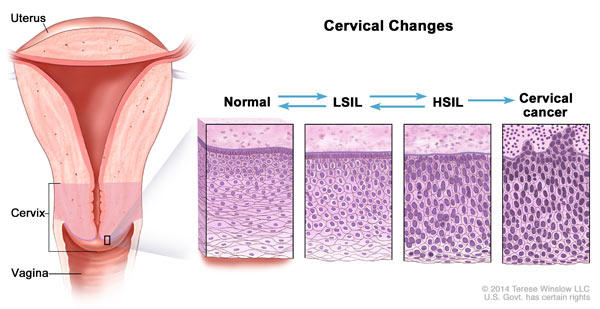
These images show how cervical cells that take long-lasting infections with high-chance HPV tin can alter over fourth dimension and go abnormal. Abnormal cervical cells may as well render to normal fifty-fifty without treatment, especially in younger women. LSIL and HSIL are ii types of abnormal changes to cervical squamous cells.
Follow-up tests and procedures after an abnormal Pap or HPV test
Keep in heed that nigh women with abnormal cervical screening test results do not have cancer. However, if you have an abnormal test result, information technology's important to get the follow-up care that your wellness intendance provider recommends.
Next Steps afterwards an aberrant Pap test, HPV test, or HPV/Pap cotest
Until recently, follow-up recommendations were based on the results of a woman'south most contempo screening exam. However, updated ASCCP risk-based management consensus guidelines advise a more than tailored approach to follow-up care.
What these updated guidelines mean is that, in add-on to your current Pap, HPV, or cotest screening result, your wellness care provider will consider additional factors when recommending follow-up care, including:
- previous screening exam results,
- previous treatments for precancerous cervical jail cell changes, and
- personal health factors, such as your age.
Based on your individual risk of developing severe cervical cell changes that could go cervical cancer, you may be advised to:
- return for a repeat HPV test or HPV/Pap cotest in i or 3 years
- have a colposcopy and biopsy
- receive handling; encounter Handling for High-Grade Cervical Prison cell Changes
These updated guidelines focus on detecting and treating severe cervical cell changes that could develop into cervical cancer while likewise decreasing testing and handling for less severe conditions (low-grade cervical cell changes).
Colposcopy and cervical biopsy
Colposcopy and biopsy are ii procedures that allow a closer look at the cells of your neck.
During a colposcopy your health care provider inserts a speculum to gently open the vagina and view the cervix. A vinegar solution will be applied to the neck to help show aberrant areas. Your wellness care provider then places an instrument called a colposcope close to the vagina. Information technology has a vivid calorie-free and a magnifying lens and allows your health care provider to look closely at your cervix.
A colposcopy usually includes a biopsy. A small piece of cervical tissue volition exist removed, or a process called endocervical curettage volition be used to accept a sample of abnormal tissue from the cervix. These cervical cells are and then checked under a microscope for signs of disease.
Talk with your wellness care provider to learn what to expect during and after your biopsy procedure. Some women have bleeding and/or belch after a biopsy. Others have pain that feels similar cramps during menstruum.
Biopsy findings: Cervical intraepithelial neoplasia (CIN)
Biopsy samples are checked by a pathologist for cervical intraepithelial neoplasia (CIN). CIN is the term used to depict aberrant cervical cells that were found on the surface of the cervix after a biopsy.
CIN is graded on a scale of 1 to 3, based on how abnormal the cells look nether a microscope and how much of the cervical tissue is afflicted. LSIL changes seen on a Pap test are generally CIN 1. HSIL changes seen on a Pap examination can be CIN ii, CIN 2/three, or CIN 3.
- CIN 1 changes are mild, or depression grade. They usually get away on their own and do non crave treatment.
- CIN 2 changes are moderate and are typically treated by removing the abnormal cells. However, CIN two can sometimes go away on its ain. Some women, afterward consulting with their health care provider, may determine to have a colposcopy with biopsy every 6 months. CIN 2 must exist treated if it progresses to CIN 3 or does non become away in one to 2 years.
- CIN iii changes are severely abnormal. Unless you are pregnant, information technology should be treated right abroad
Treatment for loftier-grade cervical prison cell changes
These treatments are used when a woman has high-grade cervical cell changes that have a high run a risk of developing into cancer.
Treatments that remove aberrant cells are called excisional treatments:
- Cold knife conization: A scalpel is used to remove a cone-shaped section of abnormal tissue. This procedure is done at the hospital and requires general anesthesia.
- LEEP (loop electrosurgical excision procedure): A sparse wire loop, through which an electrical current is passed, is used to remove abnormal tissue. Local anesthesia is used to numb the surface area. Your health intendance provider unremarkably performs this process in the office. It takes only a few minutes, and y'all will exist awake during the procedure.
Treatments that destroy abnormal cells are chosen ablative treatments:
- Cryotherapy: A special cold probe is used to destroy abnormal tissue by freezing information technology. This procedure is done in your wellness care provider's office. It takes only a few minutes and usually does not require anesthesia.
- Laser therapy: A laser (narrow beam of intense low-cal) is used to destroy abnormal tissue. This process is done at the hospital and general anesthesia is used.
Pregnancy and treatment for high-class cervical cell changes
If you are significant or programme to go meaning, your health care provider will talk with y'all nigh procedures that are recommended for you and the timing of these procedures. Depending on your specific diagnosis, you may be treated postpartum, or after delivery.
Questions to ask before handling
- What are the possible treatments for the status that I have?
- Which treatment do yous recommend for me, and why?
- What are the advantages and disadvantages of this treatment?
- What volition happen during the treatment?
- What are the possible risks of this treatment?
- How might this treatment affect a future pregnancy?
- How long will the procedure take?
- Volition general anesthesia or local anesthesia be needed?
- What side effects might I have from this procedure? How long might these side furnishings terminal?
- Are there whatsoever activities that I should avoid after the process?
Source: https://www.cancer.gov/types/cervical/understanding-abnormal-hpv-and-pap-test-results
0 Response to "2nd Biopsy for Cervical Cancer if Comes Back Unnormal Again What Next"
Post a Comment